La Busca
Paloma Rodríguez del Castillo
Listen to the poem. Then, descend.
↓
To tell the story of an unequal and eternal relationship — the one between water and humankind, going back to the very beginning of our shared history — can become an epic task, a challenge, an effort of uncertain reward.
How do you describe something that is both mother and executioner? And how do you describe the one who is only ever the victim, even when he believes himself the winner?
When, in any battle, the scales always tip to one side, what gives the eternal loser the strength to get back up, again and again, without giving in?
Perhaps it is vanity. Driven by it, man will build dams, change the course of rivers, claim land from the sea, and construct aqueducts and machines to help him find this precious resource.
Perhaps it is the need to worship her. And so he turns her into a goddess: Ahurani, Amphitrite, Salacia, Rán, Derceto, Coventina, Atabey, Yemayá, Oxum, Chalchiuhtlicue…
Perhaps it is because he needs her to wash away his sins — in baptismal fonts, sacred rivers, thermal baths and hammams.
Between love and fury, only one truth remains: the search. Curse and blessing. This is humankind's fate before water, and I have chosen to represent it through four elements: glass, sand, the remains of a forest, and a simple copper instrument pointing — directly — towards hope.
There is a question that humans have asked since the very beginning. It is not philosophical. It is not abstract. It is the most elemental of all: where is the water?
Before building cities, before tracing roads, before naming the stars, someone knelt on the earth, listening. Searching for that invisible pulse beneath layers of sand and stone. Water cannot be seen. It is sensed. It is sought with faith and ingenuity, with a pendulum and a chain, with eyes closed and a hand reaching toward the ground.
La Busca is born from that ancestral image.
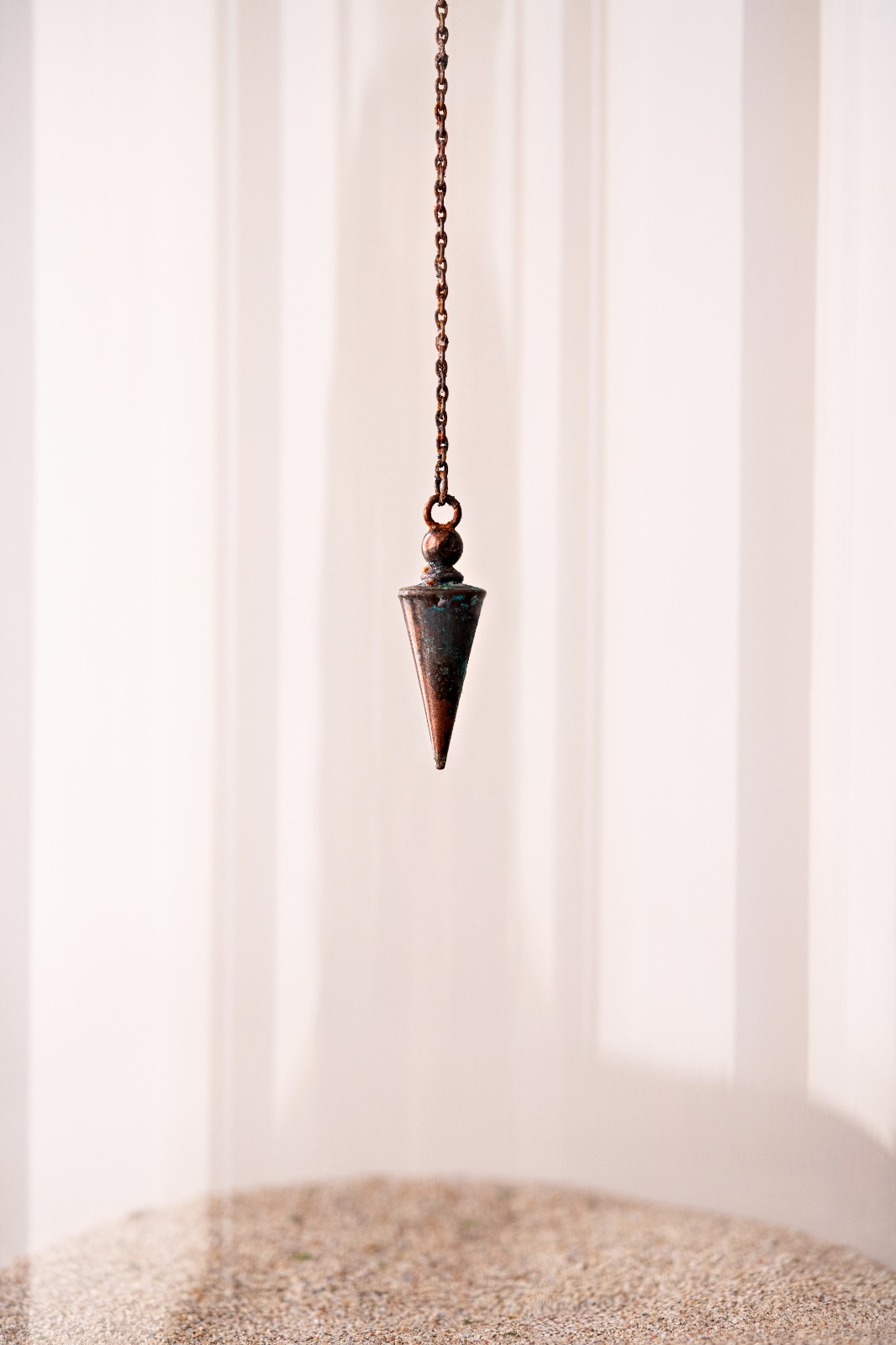
The pendulum suspended above the sand
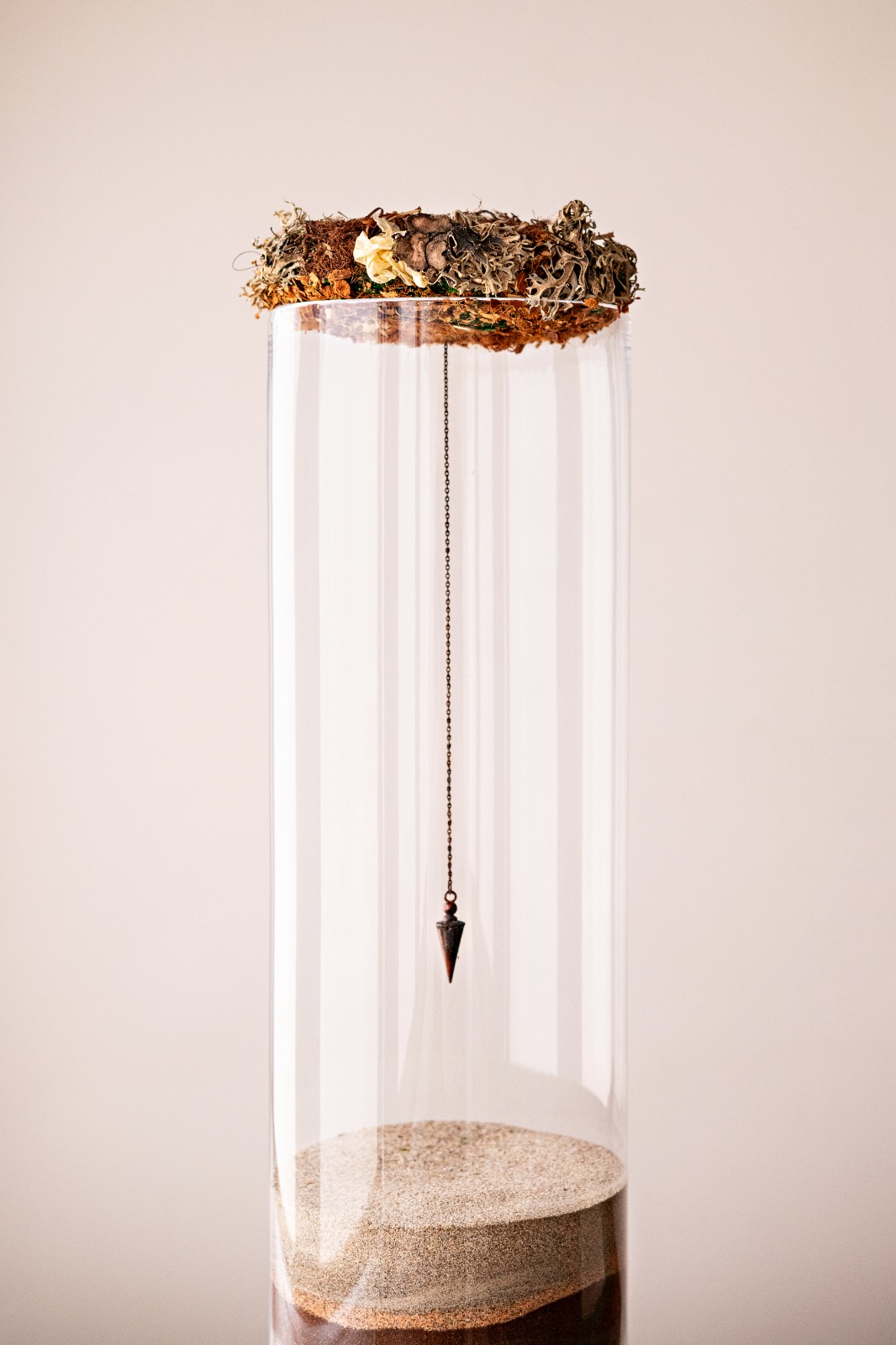
La Busca — Full view
"I didn't want to use conventional means — brushes, paints, canvas. The materials had to be ones that water recognises... the forest, the sand."
— Paloma Rodríguez del CastilloA glass cylinder rises like a fragment pulled from the earth itself. Inside, layers of sand in different tones and textures overlap — ochres, greys, whites, siennas — like a geological cross-section revealing the hidden aquifers beneath our feet. It is the earth in profile, the mineral memory of the ground.
Atop the cylinder, a vegetal crown: moss, lichen, bark, forest debris. The surface of the world. What we walk on without thinking, what covers and protects the mystery below.
And from the centre of that crown, suspended by an oxidised chain, hangs a metal pendulum. It points downward. It searches. As dowsers have done for centuries — those water seekers who crossed the fields with hazel rods and bronze pendulums, sensing in their bodies what the earth concealed.
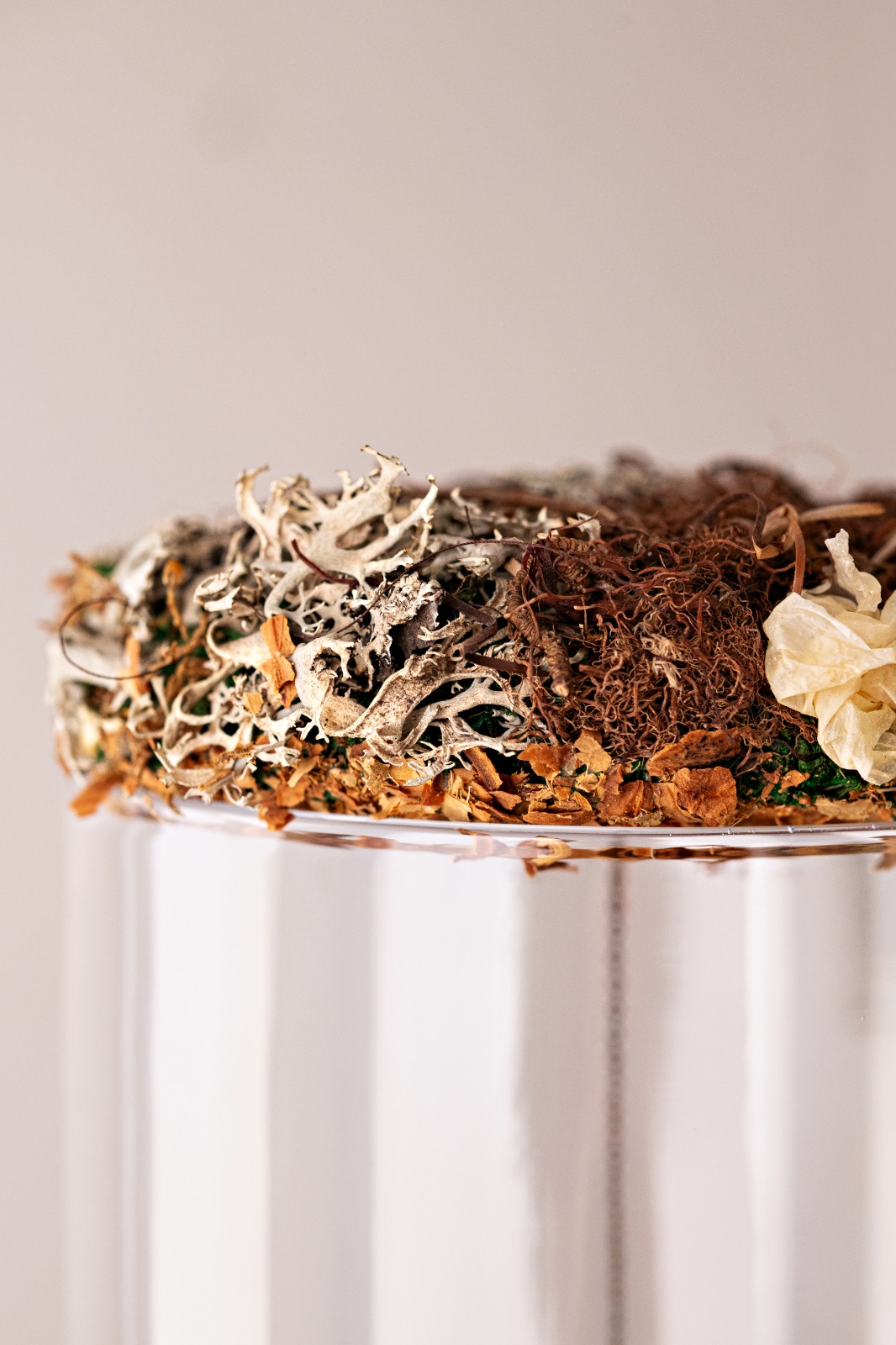
Moss, lichen, forest debris
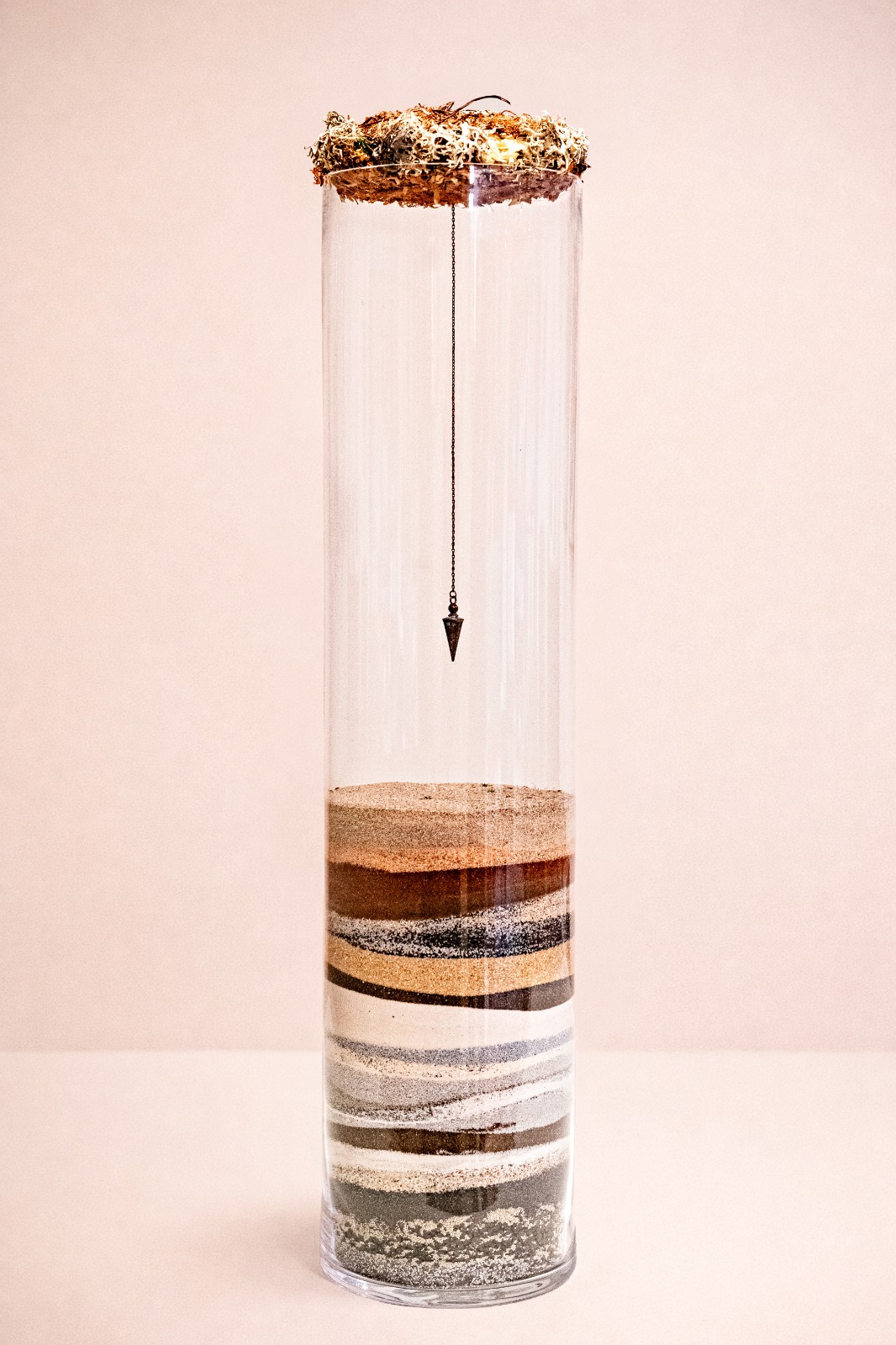
The strata: the geological memory of water
The decision to abandon conventional pictorial means is not accidental. It is a declaration. If the work speaks of water, the materials must speak its language. Sand knows water. The forest retains it. Metal points to it. Glass — transparent, fragile, a vessel — allows us to see what normally stays hidden: the layers of the world beneath the surface.
The piece is a materialised act of faith. An object that says: there is something down there. We cannot see it, but it is there. And we have spent all of human history searching for it.
- Title
- La Busca (The Search)
- Artist
- Paloma Rodríguez del Castillo Martín
- Medium
- Sculptural installation. Natural elements — sand, forest debris, moss, lichen — combined with basic human-made devices: metal pendulum, chain, glass cylinder.
- Dimensions
- Approx. 20 cm Ø × 90 cm height
- Concept
- The relationship between humans and water since the beginning. The eternal search. Survival.
- Exhibition
- AQUAM — The Paths of Water
Roman Theatre Museum, Cartagena
April – July 2026